AI webapps beat AI APIs, and the gap is the harness
Why the same model feels smarter in ChatGPT or Claude than through your API call, and the five pieces of engineering you have to rebuild yourself to close the gap.
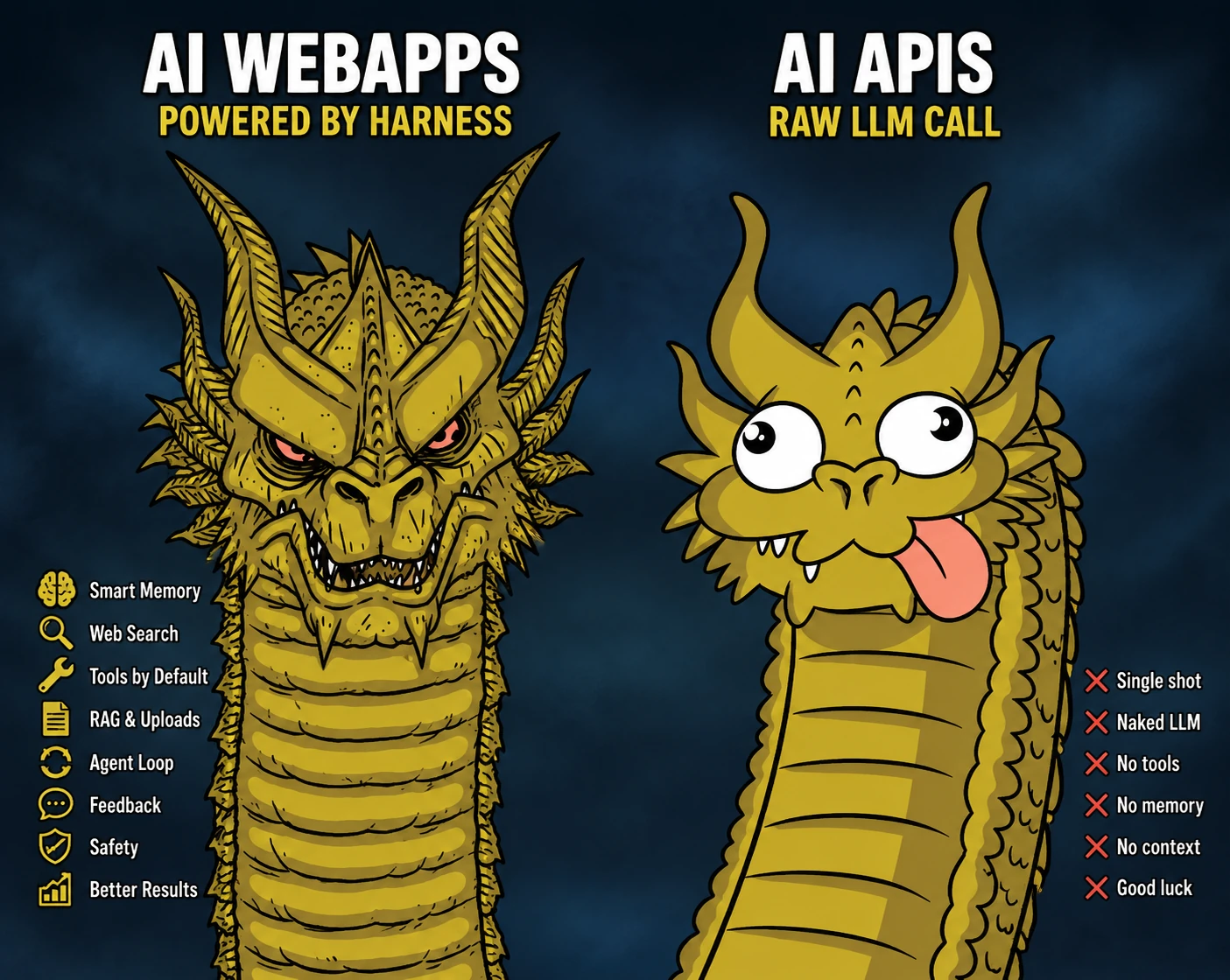
As AI engineers, we mostly use APIs to get things done programmatically. And then we hear it: “the output from your workflow isn’t as good as what I got in ChatGPT.”
The webapps are so friendly that anyone can get a great answer in one try. That same ease is what backfires on us as developers: it sets the bar.
So is it true? Yes. And in one word, that gap is the harness.
Send the same goal to both, and your API call hits a naked LLM. The webapp does a lot more before and after the model ever sees your words:
- a long, heavily tuned system prompt
- tools by default: web search, code execution, file reading
- retrieval over your uploads, plus memory across turns
- reasoning turned up, and an agentic loop that plans, calls a tool, checks, retries
- and the biggest one: you. You course-correct every turn. Your API call gets one shot.
Closing the gap
Build the harness yourself.
- Write a real system prompt: role, constraints, output contract, examples.
- Stop single-shotting. Let the model plan, act, observe, then revise.
- Give it tools and proper retrieval, not a 200-page context dump.
- Add a critique pass: a second call that reviews the first against your criteria.
- Measure it. An eval set of 30 real cases beats a hundred vibe checks.
The takeaway: the webapp isn’t a better model. It’s the same model wrapped in better engineering. That wrapper is our job.
References
Anthropic publishes the actual system prompts behind claude.ai and the mobile apps, and states outright that they do not apply to the API. Best proof of the whole point:
Tool use: how the loop actually works, plus a build-an-agent tutorial:
Adaptive thinking and effort: the current replacement for fixed thinking budgets: