What are AI agents, really?
Reasoning, tool use and memory are the three capabilities that separate an agent from a plain LLM call, RAG, or a fixed pipeline.
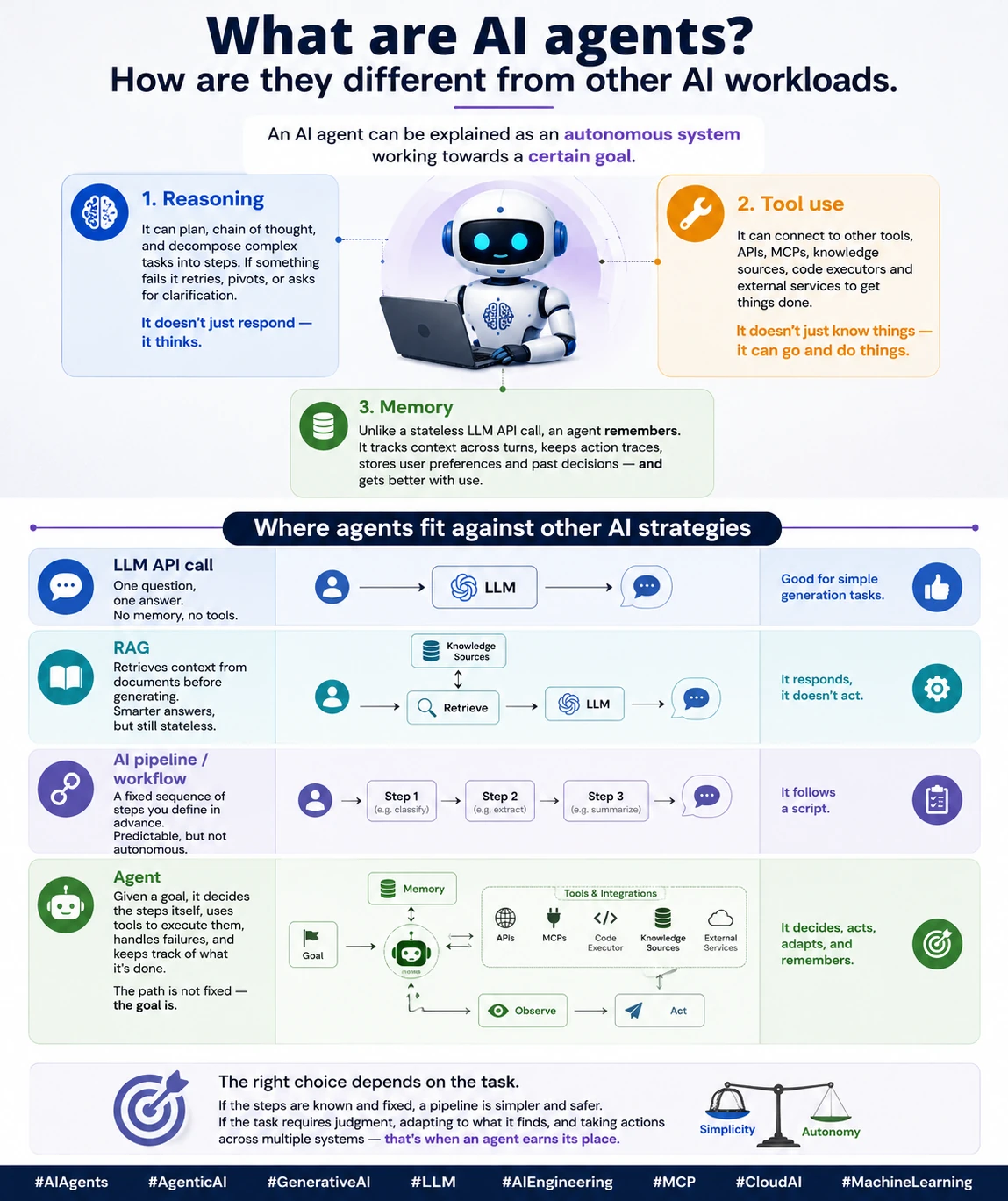
An AI agent can be explained as an autonomous system working towards a certain goal. There are three core capabilities of an agent:
1. Reasoning - it can plan, chain of thought, and decompose complex tasks into steps. If something fails it retries, pivots, or asks for clarification. It doesn’t just respond - it thinks.
2. Tool use - it can connect to other tools, APIs, MCPs, knowledge sources, code executors and external services to get things done. It doesn’t just know things - it can go and do things.
3. Memory - unlike a stateless LLM API call, an agent remembers. It tracks context across turns, keeps action traces, stores user preferences and past decisions, and gets better with use.
Where agents fit against other AI strategies
LLM API call - one question, one answer. No memory, no tools. Good for simple generation tasks.
RAG - retrieves context from documents before generating. Smarter answers, but still stateless. It responds, it doesn’t act.
AI pipeline / workflow - a fixed sequence of steps you define in advance. Predictable, but not autonomous. It follows a script.
Agent - given a goal, it decides the steps itself, uses tools to execute them, handles failures, and keeps track of what it’s done. The path is not fixed - the goal is.
The right choice depends on the task. If the steps are known and fixed, a pipeline is simpler and safer. If the task requires judgment, adapting to what it finds, and taking actions across multiple systems, that’s when an agent earns its place.