AI Gateways: the command centre for enterprise AI
As every team rolls out its own chatbots and agents, simple questions - what are we spending, which models are in use, are we auditable - get hard fast. An AI Gateway is the central entry point that keeps them answerable.
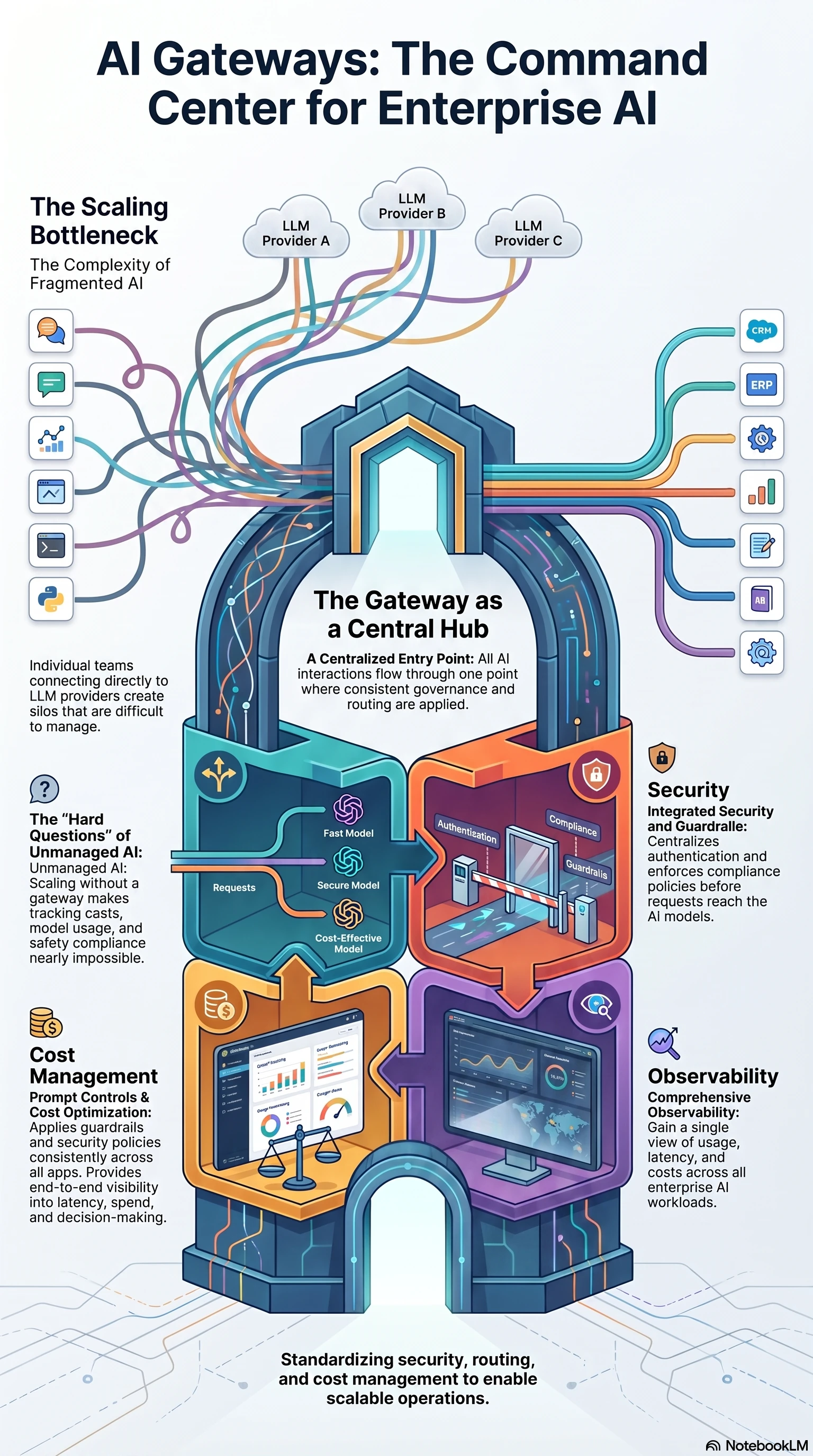
Today, organizations are rolling out AI across the business faster than ever.
Across the organization, different teams are building chatbots, rolling out AI agents, and integrating LLMs into existing applications… new use cases are emerging every week.
And suddenly simple questions become hard: what are we spending on AI across teams, which models and tools are being used where, why did an AI agent make that decision, are we meeting auditing requirements, and can we enable or disable capabilities safely without breaking things?
This is where an AI Gateway comes in.
Think of it as the central entry point for all AI interactions within an enterprise. Rather than every application connecting directly to different LLM providers, requests flow through the AI Gateway, where security, governance, routing, observability, and cost controls are applied consistently.
An AI Gateway enables organizations to:
- Route requests to the most suitable AI model
- Enforce security and compliance policies
- Apply guardrails and prompt controls
- Monitor usage, latency, and costs
- Centralize authentication and access management
- Gain end-to-end observability across AI workloads
Just as API Gateways became essential for managing microservices, AI Gateways are becoming a foundational component of enterprise AI architectures.
Building AI is only the beginning. Operating AI at enterprise scale is the next challenge and AI Gateways are designed to solve it.